
A player wins several matches, reaches a quarter-final and then drops in the rankings. How can a good tournament send her backwards? Often, an even better result from the previous year has just dropped out of her total.
That is why “she lost ranking points” does not automatically mean “she played badly”. To understand the movement, you need to look at the points coming in, the points going out and the players around her.
This guide focuses on singles. It explains the main calculation, what fans mean by defending points and why the Race to the WTA Finals can show a different order.
How WTA Rankings Work
The main singles ranking uses a rolling 52-week period. A player normally counts up to 18 tournament results, with the WTA Finals able to count as an additional 19th.
The WTA’s rankings explainer also sets out required tournament categories for top players. These include the four Grand Slams, the best six combined WTA 1000 results, the best one WTA-only 1000 result and the next best seven eligible results. Mandatory-event rules and exceptions affect what counts.
That means a player cannot always choose any 18 tournaments and leave out the rest.
To understand a ranking change, start with the results currently counting in her total.
What Does Defending Points Mean?
“Defending points” is shorthand for replacing an earlier result as it leaves the ranking window. Her old points expire whether or not she returns to that tournament.
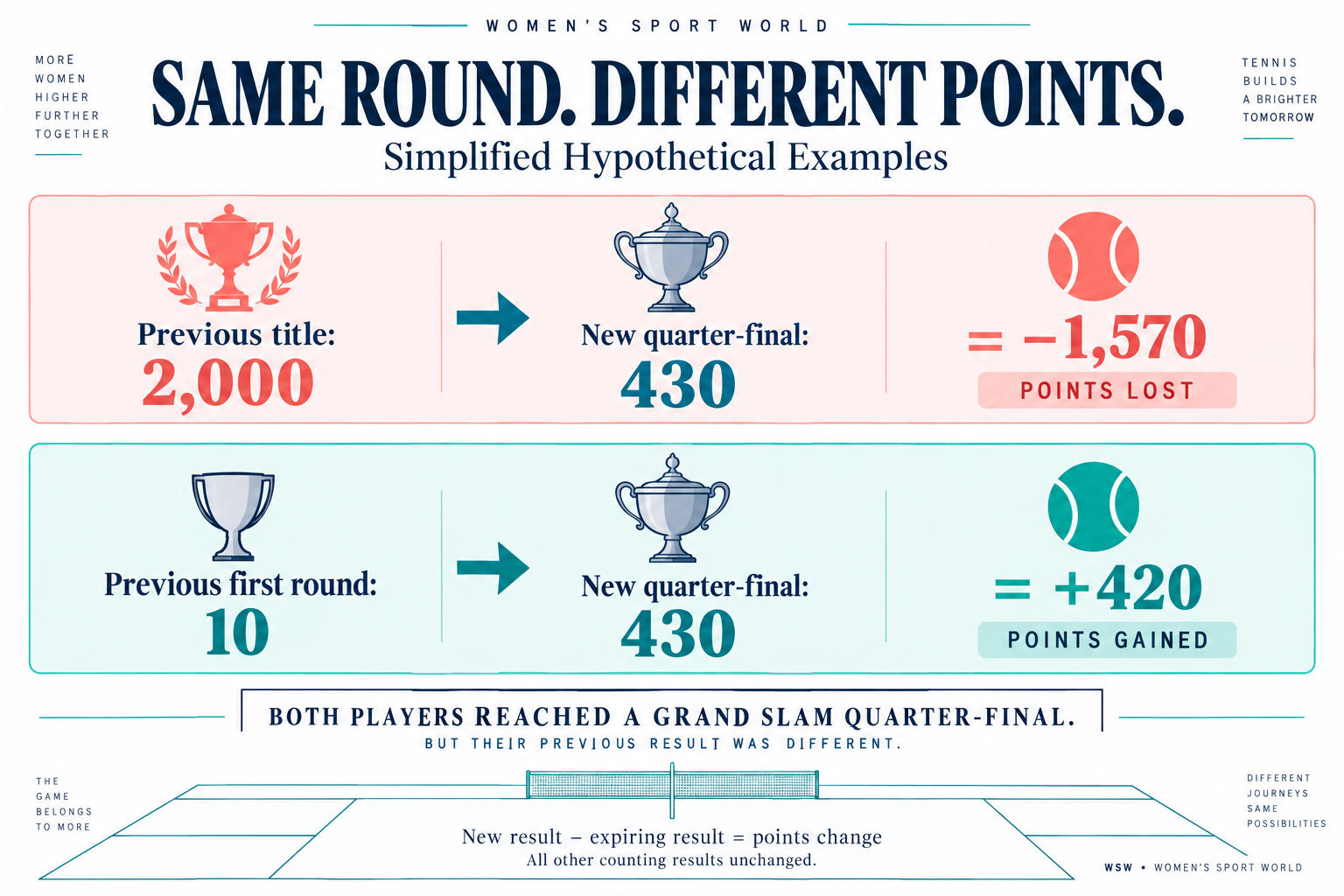
Imagine a fictional player who won a Grand Slam a year ago. That title earned 2,000 points. This time, she reaches the quarter-finals, worth 430.
Assume the old result expires, the new one replaces it and all her other counting results stay the same. Her total falls by 1,570 points: 430 minus 2,000.
A quarter-final is still a strong run. It simply earns fewer points than the title she won last time.
Now reverse the situation. A fictional player replaces a first-round Grand Slam result worth 10 points with a quarter-final worth 430. The change is a gain of 420.
Both players have reached the same round this time. One loses points; the other gains them. The difference is what they did last year.
These examples keep the arithmetic simple. For a real player, check the official expiry dates and her full points breakdown, including any exceptions.
How Many Points Does A Tournament Win Earn?
For singles champions, the main tournament levels award 2,000 points at a Grand Slam, 1,000 at a WTA 1000, 500 at a WTA 500 and 250 at a WTA 250. The official WTA points table lists the awards for the other finishing rounds too.
The points listed for a round are the award for finishing there. A main-draw player does not add the first-round, second-round and quarter-final awards together to create her quarter-final total. Qualifying has its own provisions, so use the detailed table when checking a qualifier’s result.
The scale helps explain why two players with the same number of trophies can have very different totals. The events and the rest of their results matter.
Four 250-point titles add up to 1,000 points before counting rules are considered. One Grand Slam title is worth twice that amount.
That comparison concerns ranking value only. It does not tell you which tournament was harder to win, how strong the draw was or how well a player performed in a particular match.
Why Playing More Does Not Always Mean Adding More
Playing another tournament does not necessarily increase a player’s ranking total. She may already have enough results to fill her available places.
Take a hypothetical example: a player has a 100-point result in her total and earns 150 points at another event that is allowed to replace it. She gains 50 points overall.
Now imagine the new result is worth 80. If it cannot replace a stronger counting result and no other rule requires it to count, it does not increase that total.
These are illustrative totals; whether a result can replace another depends on the counting rules.
The practical lesson is to check the player’s breakdown before treating a new tournament award as her net gain. “She earned 150 points” and “her ranking total rose by 150” can describe different things.
Can A Player Gain Points And Still Fall In The Rankings?
Yes. Her points total and her ranking position are related, but they are not the same number.
Imagine three fictional players starting a week on 3,000, 2,950 and 2,900 points. The leader adds a net 50 and reaches 3,050.
The other two add a net 200 each. They finish on 3,150 and 3,100, passing her.
The first player improved her total but dropped two places within this group. She did not lose points; her rivals gained more.
The reverse can happen as well. A player may lose points yet hold her position if the athletes below her do not pass her. Or she may rise because others lose more.
When a headline says someone “fell”, ask whether it refers to her position or her total. Then look at the gap to the names directly above and below her.
WTA Rankings And The Race To The Finals Are Different
The main rankings follow a rolling 52-week period. The Race tracks qualification for the season-ending WTA Finals over a separate period.
You will often hear the Race described as a calendar-year table. The current WTA Rulebook is more precise: the Race Year begins with tournaments starting in the week before the previous Finals and ends with those starting two weeks before the current Finals. Finals results are excluded.
The rulebook also excludes WTA 125 and ITF results from singles Race points. That is another reason the Race should not be treated as a copy of the main ranking.
For the actual order, check the official singles Race standings. Use that table when discussing Finals qualification, and the main singles ranking when discussing a player’s world ranking.
Under the 2026 rules, the top seven in the Race qualify. The eighth place goes to the highest-placed current-year Grand Slam champion ranked 8–20 in the Race who has not already qualified. If there is no such champion, it goes to the next player in the Race, starting at eighth.
Players must also have played at least eight WTA 1000 or WTA 500 tournaments during the Race Year, unless they qualify for the long-term injury exception.
So “the top eight automatically go” can miss an important exception.
Does A Higher Ranking Mean A Player Should Win?
A higher ranking tells you about a player’s results over time. It cannot guarantee what will happen in her next match.
It does not, by itself, explain whether one player’s return game matches up well against the other’s serve. Nor does the number beside a name tell you how confidently she is moving that day.
For match analysis, put the ranking beside what is happening on court. Is the higher-ranked player earning short balls? Is the returner reading the serve? Who is controlling the rallies under pressure?
A lower-ranked player can have the better answers in that match without making the ranking system meaningless.
Rankings also change much faster than a player’s career record. For a look at major titles across the years, see our guide to women’s tennis Grand Slam champions.
How To Read The Next Ranking Update
Begin with the movement being reported. Is it a change in points, a change in position or a Race update?
Next, compare the incoming result with the result leaving the total. Then check whether a new score replaces another counting result rather than being added in full.
Finally, check the players around her. Someone else’s strong week can push her down a place even when her own total has improved.
You do not need to calculate the whole tour by hand. These checks are enough to understand why “quarter-finalist” and “down three places” can both be fair descriptions of the same week.
Seen a ranking change that surprised you? Tell us the player and tournament in the comments.