
How To Play Women's Basketball: Rules, Positions, Court Size And Fundamentals
A clear, beginner-friendly guide to understanding the rules, positions, and essential skills that make women’s basketball click—on and off the court.
Maybe your daughter just made the school team and you want to understand what you’re watching. Or you’ve been thinking about joining that recreational league but feel intimidated by how fast the game looks. Perhaps you’re coaching for the first time and need to explain the basics clearly. Whatever brought you here, you’re in the right place.
The fundamentals that separate good players from great ones aren’t complicated. They’re repeatable skills that reward smart decisions and teamwork more than raw athleticism. And once you understand the structure: the court, the rules, the positions, everything else starts to click.
This guide walks you through everything you need to know, from court dimensions and game length to position breakdowns and the drills that actually make you better. By the end, you’ll have a clear roadmap for playing with confidence, whether you’re stepping on the court for the first time or helping someone else get started.
What Women’s Basketball Actually Looks Like
When we talk about women’s basketball, we’re referring to the organized competitions and development pathways that stretch from youth leagues all the way up to professional franchises and national teams. The game is governed by several major organizations, each with its own official rulebook:
• FIBA (International Basketball Federation) sets the rules for most international competitions, the Olympics, and many domestic leagues worldwide. If you’re watching basketball outside North America, you’re probably seeing FIBA rules in action. Visit FIBA’s official rules page for the complete rulebook.
• The WNBA is the premier professional league in the United States, with its own rulebook and growing visibility. If you want to see the highest level of women’s basketball in North America, check out WNBA.com.
• The NCAA governs college basketball in the US, with its own women’s rulebook that gets updated annually. College basketball is a crucial development pathway and a major source of entertainment. Learn more at NCAA Women’s Basketball.
If you’re learning at school or in a local club, your coaches will typically follow rules closely aligned with either FIBA or NCAA standards, depending on where you’re playing.
Women’s Basketball Court Dimensions: What You Need To Know
Understanding the court layout helps you make sense of spacing, shooting range, and defensive positioning. While the exact measurements vary slightly depending on whether you’re playing under FIBA or NCAA/WNBA rules, the overall structure stays consistent.
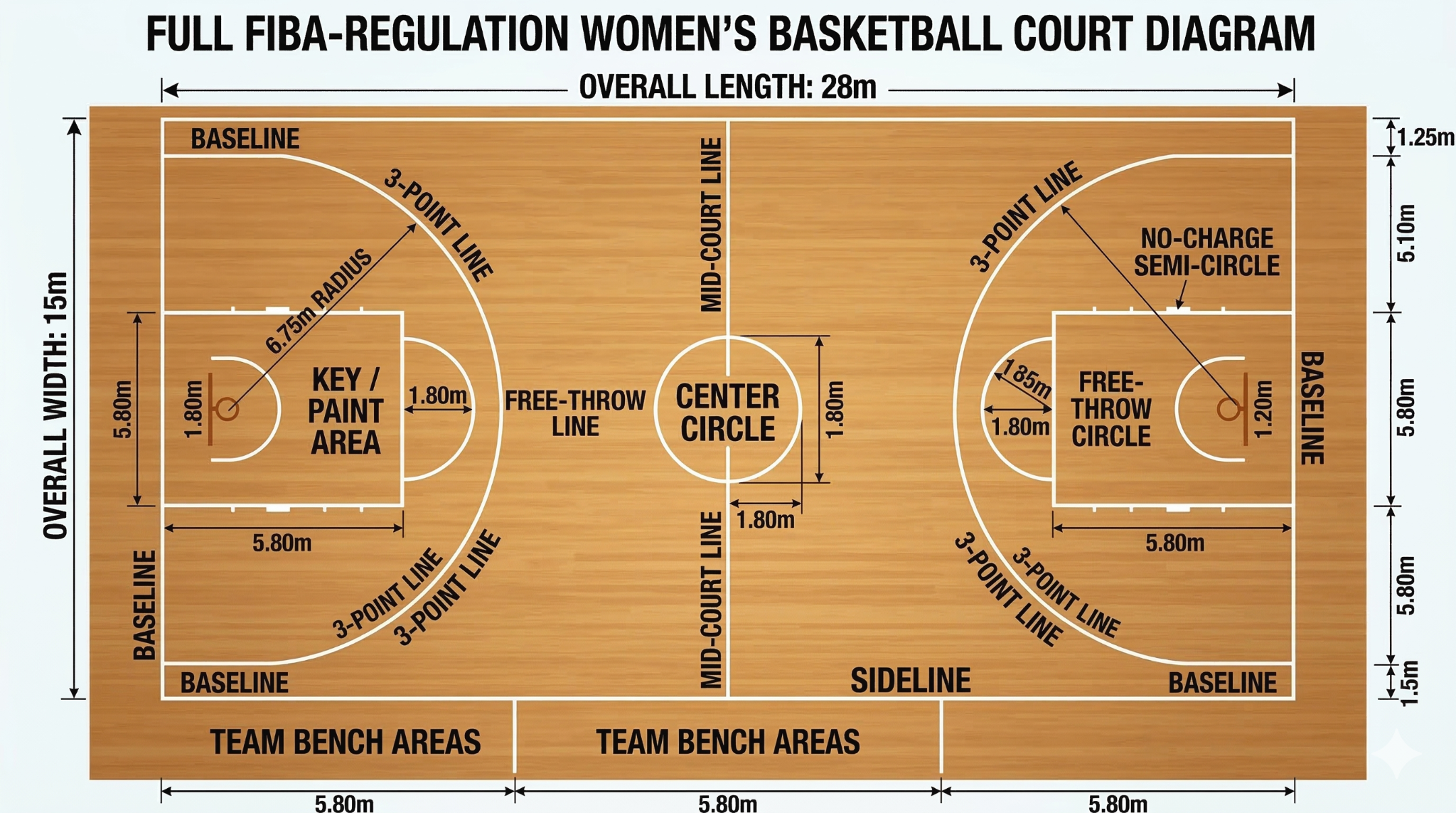
FIBA Court Dimensions
A regulation FIBA court measures 28 meters by 15 meters (about 92 feet by 49 feet if you’re thinking in imperial measurements). That’s roughly half the size of a football field, enough space that positioning and conditioning really matter.
Key markings you’ll notice:
• The three-point line forms an arc 6.75 meters from the basket, connected to parallel lines near the corners. Anything shot from outside this arc is worth three points instead of two.
• The free-throw line sits 5.80 meters from the baseline. This is where you’ll shoot free throws after certain fouls.
• The key or paint is the rectangular area under each basket where offensive players can only stay for three seconds at a time.
NCAA and WNBA Court Dimensions
In NCAA and WNBA competition, you’ll see the slightly larger 94-foot by 50-foot court layout. The three-point line sits at 22 feet, 1¾ inches from the basket (measured to the outside edge of the arc), with specific corner measurements.
Why this matters when you’re learning: On a wider, longer court, spacing becomes more demanding. You need sharper footwork to create separation from defenders and quicker decision-making to beat help defense before it arrives. If you’re used to practicing on a shorter court and suddenly play on a regulation-size one, expect to feel the difference in your conditioning.
How Long Are Women’s Basketball Games?
Regulation game time depends on which organisation is running the competition, but women’s basketball commonly uses four quarters of 10 minutes each, 40 minutes of total game clock.
Here’s the breakdown:
• FIBA: Four 10-minute quarters; overtime periods are five minutes.
• WNBA: Four 10-minute quarters; five-minute overtime.
• NCAA Women: Four 10-minute quarters; five-minute overtime.
If you’re planning to watch a game or play in one yourself, budget about 90 minutes to two hours of real time. Those 40 minutes of game clock stretch significantly with timeouts, foul shots, official reviews, and strategic stoppages.
Practical tip: Treat the game like a series of high-intensity sprints rather than a marathon. The best conditioning often comes from developing efficient movement habits, balanced stance, smart footwork, and intelligent spacing, rather than just running more.
Women’s Basketball Positions Explained
Basketball lists five traditional positions, but modern basketball is really more about roles than rigid labels. The best players can do multiple things, and coaches increasingly value versatility. Still, understanding the traditional positions gives you a useful learning framework.
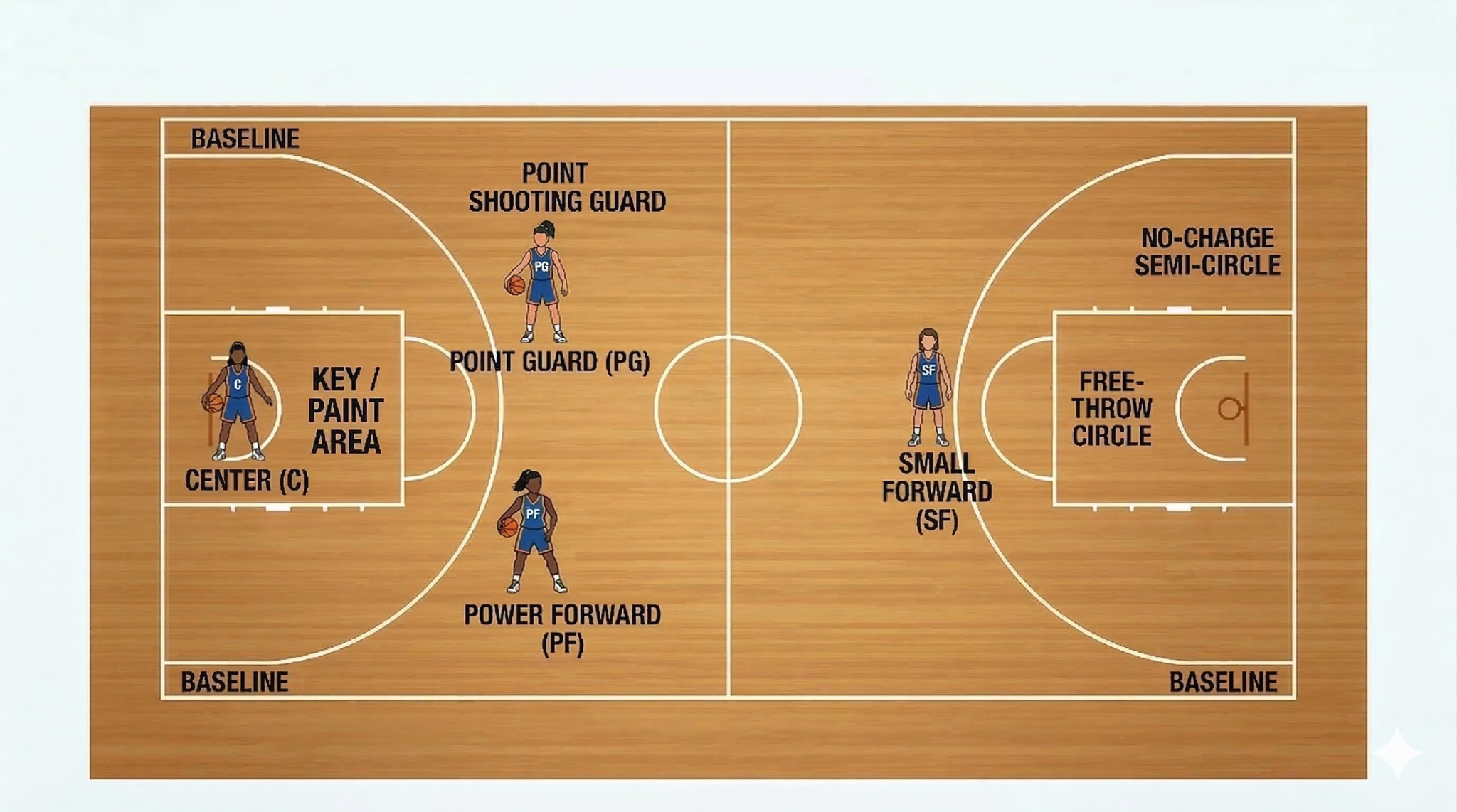
Point Guard (PG)
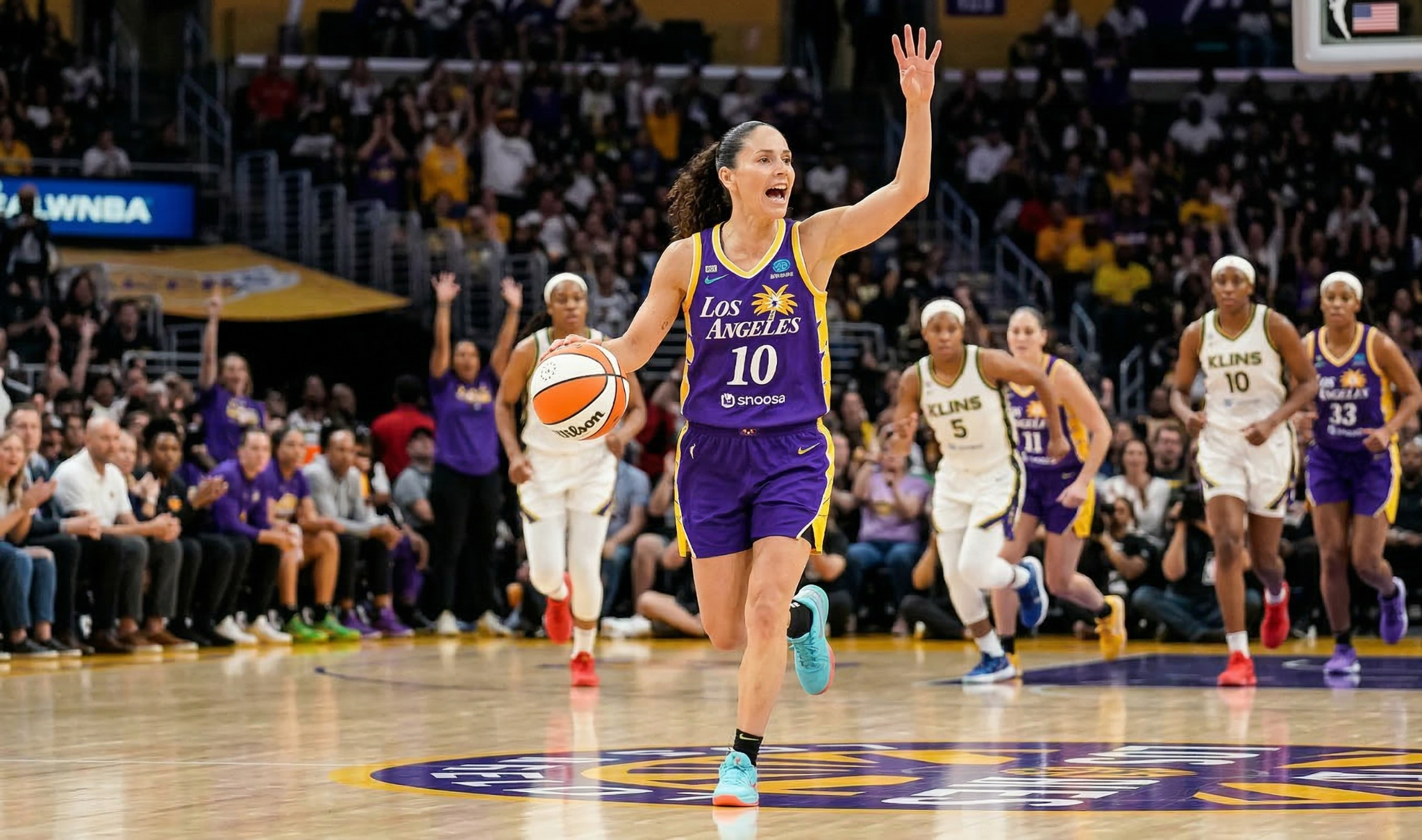
The point guard runs the show. Think of legendary players like Sue Bird or Courtney Vandersloot, they control the tempo, make the right reads, and get teammates involved while knowing exactly when to attack. The point guard brings the ball up the court, calls plays, and serves as the coach’s extension on the floor.
A good point guard values safe passes, keeps everyone engaged, and attacks strategically to collapse the defense and create open shots for teammates.
Key skills:
• Ball-handling under defensive pressure
• Passing on time and on target
• Reading defenses and using screens effectively
• Court awareness and decision-making
Beginner focus: Keep your dribble alive, protect the ball with your body, and make the easy pass early rather than forcing difficult plays.
Shooting Guard (SG)
The shooting guard is your primary perimeter scorer. She attacks closeouts, runs off screens to get open, and spaces the floor to punish help defense. Modern shooting guards need to do more than just shoot, they handle the ball, create their own shots, and defend quick scorers on the other end.
Key skills:
• Catch-and-shoot footwork (getting your feet set before or as you catch)
• One- or two-dribble pull-up shots
• Moving without the ball: smart cuts and relocations
• Defensive quickness and endurance
Beginner focus: Work on getting your feet set before the catch so you can shoot quickly. Practice the catch-and-shoot motion until it feels automatic.
Small Forward (SF)
The small forward is your versatile connector, the player who does a little bit of everything. She might cut to the basket, post up smaller defenders, rebound, defend multiple positions, and play both inside and outside. If you like variety and adaptability, this role often fits well.
Key skills:
• Finishing at the rim while moving at speed
• Defensive versatility (guarding guards and forwards)
• Smart cutting and spacing awareness
• Rebounding from the wing positions
Beginner focus: Learn to cut hard to the basket whenever your defender turns their head to watch the ball. Timing your cuts creates easy scoring opportunities.
Power Forward (PF)
The power forward battles inside but also operates in space in modern offenses. She sets screens, crashes the boards, defends physical players, and can create mismatches with face-up drives or mid-range shots. It’s a position that rewards toughness and basketball IQ.
Key skills:
• Setting solid, legal screens
• Box-outs and physical rebounding
• Short rolls to the basket after setting screens
• Quick decision-making in the mid-range area
Beginner focus: Master the fundamentals of rebounding, box out with technique (make contact first), then pursue the ball aggressively.
Center (C)
The center anchors the paint on both ends of the floor. She protects the rim on defense, controls rebounding, sets strong screens, and finishes efficiently near the basket on offense. Centers in women’s basketball often combine traditional post skills with the ability to step out and shoot or make plays from the high post.
Key skills:
• Post moves and footwork near the basket
• Rim protection and shot-blocking
• Rebounding on both ends
• Setting solid screens to free up teammates
Beginner focus: Work on establishing position early. Being in the right spot is more valuable than trying to be the tallest player on the court.
Women’s Basketball Rules Explained
The basic objective is simple: score more points than the other team by shooting the ball through your opponent’s basket. But to play effectively, you need to understand the key rules that govern movement, scoring, and fouls.
How Scoring Works
• Two points: Any shot made from inside the three-point arc
• Three points: Any shot made from outside the three-point arc
• One point: Each successful free throw (awarded after certain fouls)
Shot Clock Rules
The shot clock limits how long your team can possess the ball before attempting a shot. This keeps the game moving and prevents stalling tactics.
• FIBA: 24-second shot clock
• WNBA: 24-second shot clock
• NCAA Women: 30-second shot clock (as of recent rule changes)
Backcourt Violation
Once your team brings the ball across half-court into the frontcourt, you can’t pass or dribble it back into the backcourt. You also have a limited time to advance the ball:
• FIBA and WNBA: 8 seconds to advance the ball past half-court
• NCAA Women: 10 seconds to advance the ball
Common Violations (Result in Loss of Possession)
• Travelling: Moving your pivot foot illegally or taking too many steps without dribbling. This is one of the most common violations for beginners.
• Double dribble: Dribbling, stopping (putting two hands on the ball or holding it), then dribbling again.
• Carrying or palming: Putting your hand under the ball while dribbling, essentially carrying it.
• Out of bounds: Stepping on or over the boundary line while holding the ball.
• Three-second violation: Offensive players can’t stand in the key (paint area) for more than three consecutive seconds without leaving (rule details vary by competition).
Personal Fouls (Can Lead to Free Throws)
• Personal foul: Illegal contact like hand-checking, blocking, pushing, or holding.
• Shooting foul: Contact on a player while they’re shooting, which typically awards free throws.
• Offensive foul (charge): When an offensive player initiates illegal contact, often by lowering their shoulder or running into a defender who has established position.
Beginner focus: Defend with your feet first. If your feet are in the right place, your hands won’t need to reach and foul. Good defensive positioning beats aggressive hand-checking every time.
Basketball Fundamentals For Women: Skills That Actually Matter
The fundamentals below translate to every level, school teams, club basketball, college, professional leagues, and international competition. Master these core skills and the rest of the game becomes easier to learn.
1. Athletic Stance and Footwork
Your base position affects everything you do on the court, shooting, defending, cutting, and rebounding. A balanced stance gives you the foundation to move quickly in any direction.
Stance checklist:
• Feet shoulder-width apart
• Knees bent, hips back (not straight-legged)
• Chest up, eyes forward
• Hands active, elbows relaxed
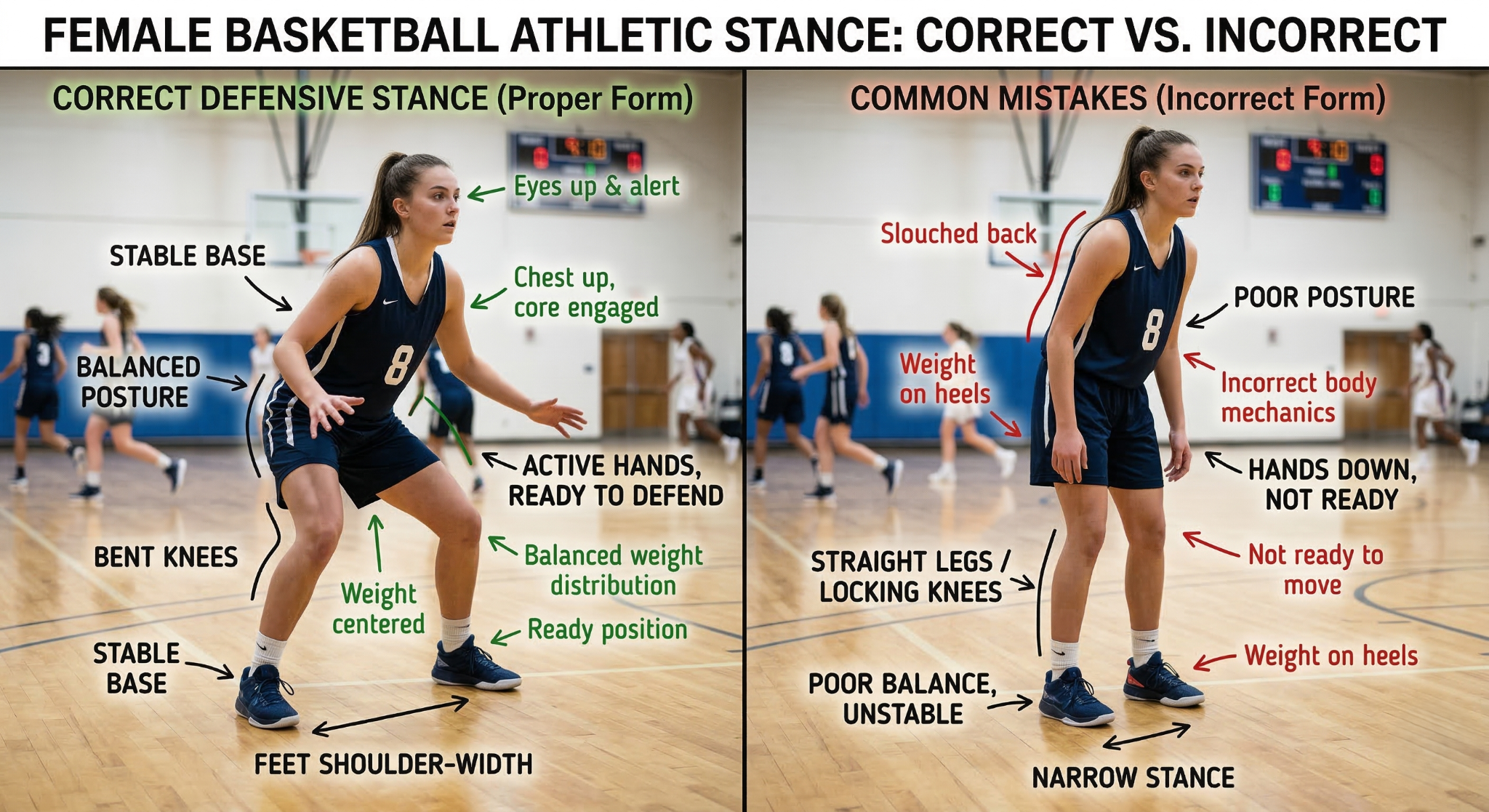
Drill: Defensive slides (3 sets of 20 seconds)
Slide laterally left and right without crossing your feet or bouncing up and down. Keep your head level, maintain your defensive stance throughout, and focus on quick direction changes. This builds the lateral quickness you’ll need to stay in front of offensive players.
2. Dribbling Under Pressure
A useful dribble is controlled and protected, not flashy. You need to be able to advance the ball against pressure and protect it from defenders trying to steal.
Key principles for beginners:
• Dribble low when defenders pressure you; dribble higher in open space to move faster
• Use your body as a shield between the ball and the defender
• Keep your eyes up to see the court (start by glancing up, then progress to scanning constantly)
• Practice with both hands, being predictable makes you easy to defend
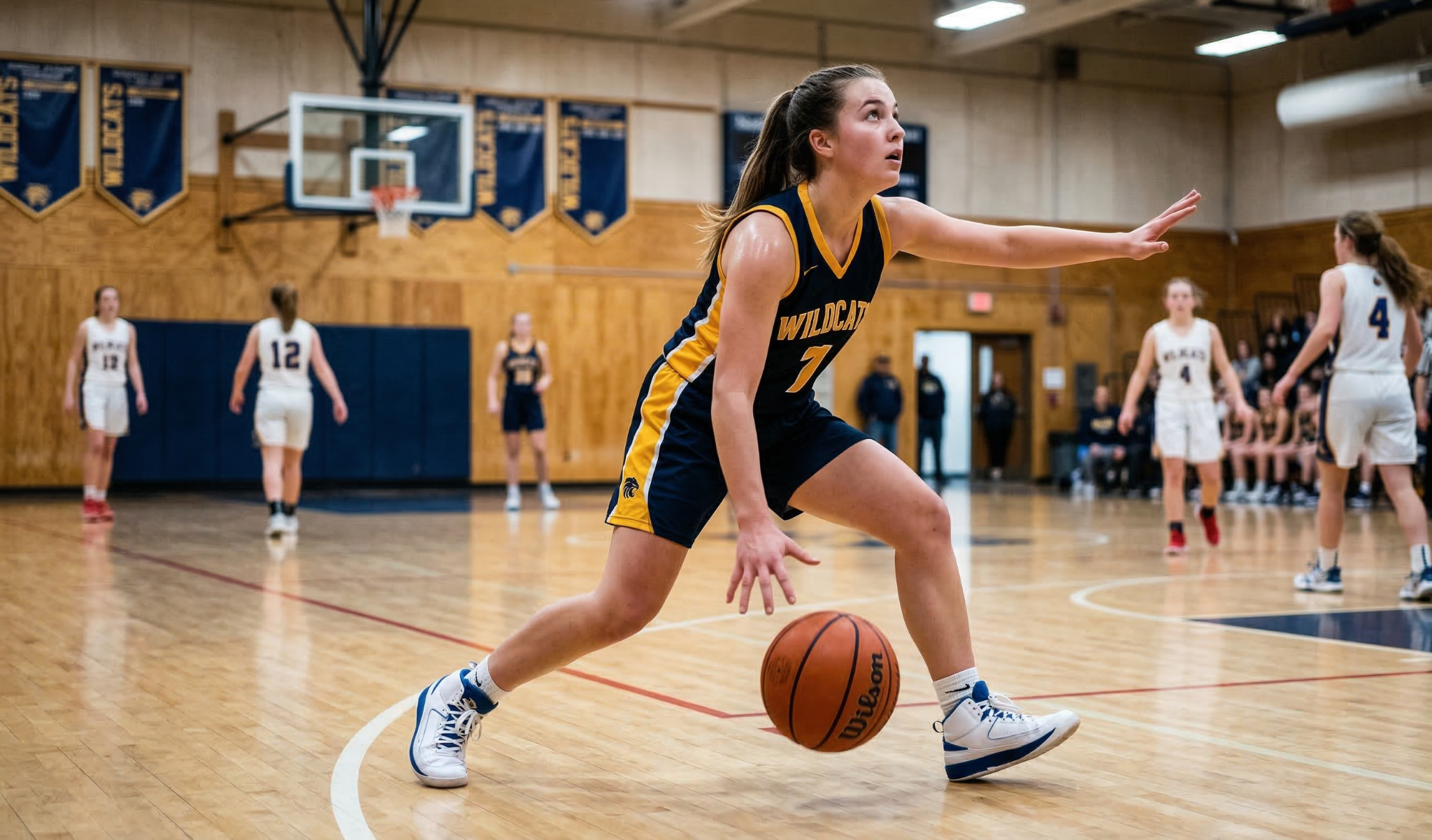
Drill: Stationary ball control (5 minutes)
Start with stationary dribbling to build comfort. Do 30 seconds of pound dribbles with your right hand (hard, aggressive dribbles straight down), then 30 seconds with your left. Then do 30 seconds of crossovers (dribble from right hand to left and back). If you have access to two basketballs, try dribbling both at once for 30 seconds to really challenge your coordination.
3. Passing: The Fastest Way To Score
Great teams move the ball quickly and accurately. The ball travels faster than any defender can run, so smart passing creates better scoring opportunities than dribbling alone.
Essential passes to learn:
• Chest pass: The quickest pass in open space, push from your chest with both hands, step toward your target
• Bounce pass: Best for hitting a cutter or feeding a post player in traffic, aim for the ball to bounce about two-thirds of the way to your target
• Overhead pass: Useful for skip passes to the opposite side of the court, especially when defenders have their hands in passing lanes
Beginner technique tip: Step toward your target as you pass. Power comes from your legs and hips, not just your arms. A strong step gives you accuracy and velocity.
Drill: Wall passing (5 minutes)
Find a sturdy wall and mark a target at chest height. Complete 50 chest passes, 50 bounce passes, and 25 one-hand push passes with each hand. Focus on hitting your target consistently and catching cleanly. This simple drill builds passing strength and accuracy.
4. Shooting: Start Close, Then Extend Your Range
A repeatable shot is more valuable than a pretty shot. Focus on building consistent mechanics before worrying about range or style.
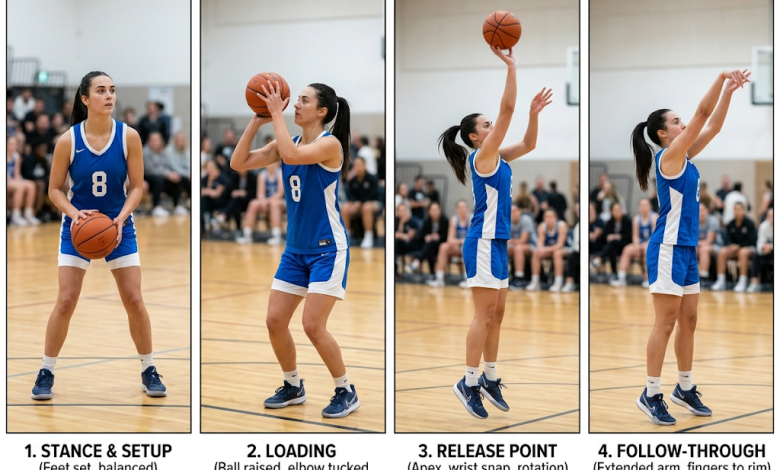
Simple shooting sequence:
1. Feet set: Get balanced with feet shoulder-width apart (or hop/one-two step into balance)
2. Elbow alignment: Keep your shooting elbow under the ball, not flared out to the side
3. Wrist snap: Snap your wrist on release to create backspin on the ball
4. Follow-through: Hold your follow-through with fingers pointing toward the rim, this ensures you’re shooting through the target, not at it
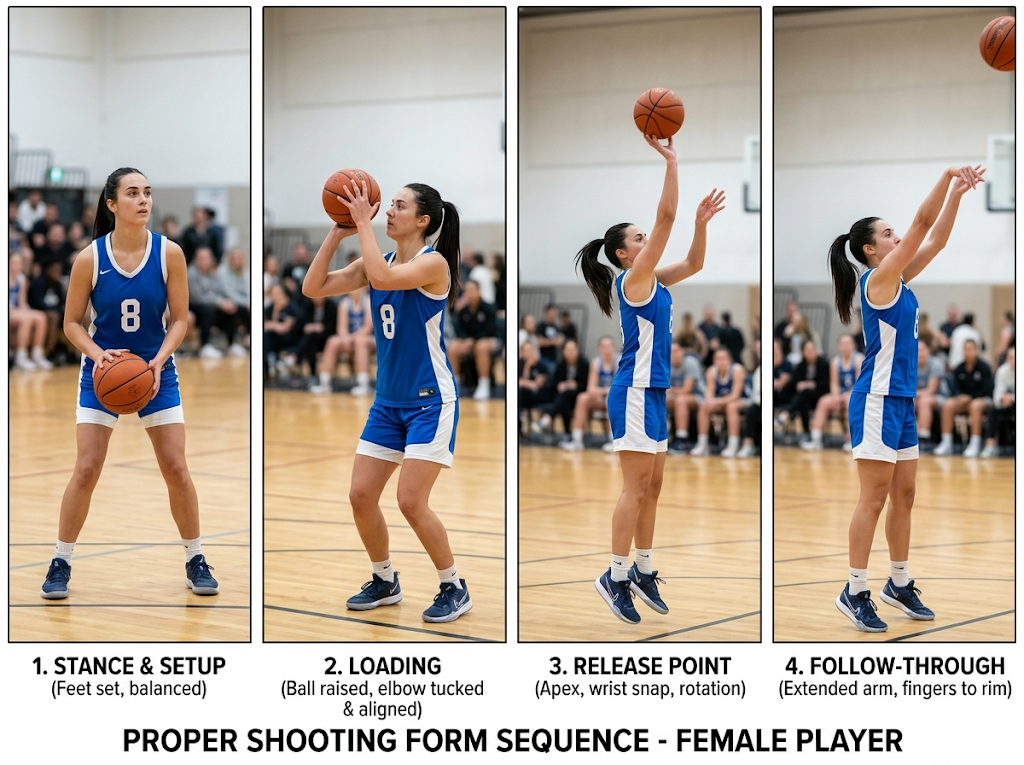
Drill: Form shooting (25 makes)
Stand close enough to the basket that you don’t need much power, maybe five feet away. Focus entirely on perfect form: feet set, elbow under the ball, good wrist snap, full follow-through. Make 25 shots with perfect technique. Once you’re making them consistently, step back one spot and repeat. Build range gradually as your form stays solid.
5. Finishing: Lay-Ups Are Your First Scoring Tool
Most beginner points come from lay-ups and free throws. Master the lay-up from both sides and you’ll have a reliable scoring option every game.
Key principles:
• Use the backboard: Aim for the top corner of the square on the backboard, it’s a much bigger target than the rim
• Protect the ball: Keep the ball on the side of your body away from defenders, use your body as a shield
• Finish through contact: Stay balanced even when defenders bump you, don’t force the shot, just finish smoothly
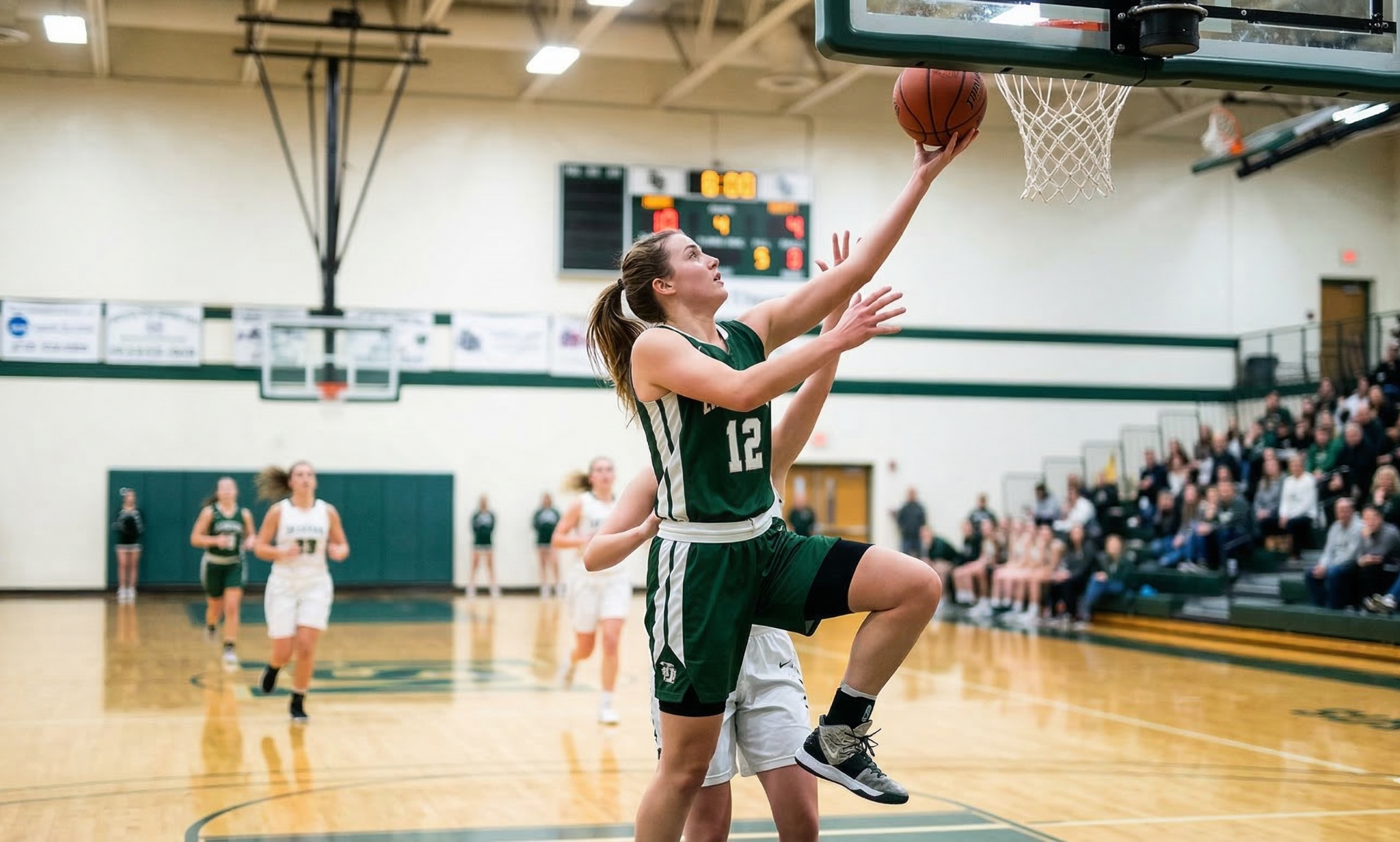
Drill: Mikan drill (1 minute continuous)
Stand directly under the basket. Shoot a right-handed lay-up off the backboard, catch the ball before it bounces, immediately step to the left side of the rim and shoot a left-handed lay-up. Keep alternating sides for one minute without stopping. This drill builds ambidextrous finishing, touch around the rim, and conditioning all at once. It’s one of the most efficient fundamental drills in basketball.
6. Defense: Contain First, Then Help
Team defense works like a chain, one weak link creates an easy lay-up for the other team. Your job is to make the offense work harder for every shot.
Core defensive concepts:
• Contain: Your first job is stopping straight-line drives to the basket, stay between your player and the rim
• Close out: When running at a shooter, sprint halfway there, then chop your steps with hands up, this lets you stop quickly without fouling
• Help and recover: Show help when a teammate gets beat, then sprint back to your own player
Beginner principle: If your player doesn’t have the ball, you should be able to see both your player and the ball. This positioning lets you help and recover effectively.
7. Rebounding: Technique Beats Height
Rebounding is about timing and positioning more than jumping ability. Players who understand the fundamentals consistently out-rebound taller opponents.
Three-step rebounding system:
5. Find: Locate the player you’re responsible for boxing out
6. Hit: Make contact with your hips and back (not your hands, that’s a foul), creating space between them and the basket
7. Get: Pursue the ball aggressively with both hands, grabbing it at its highest point
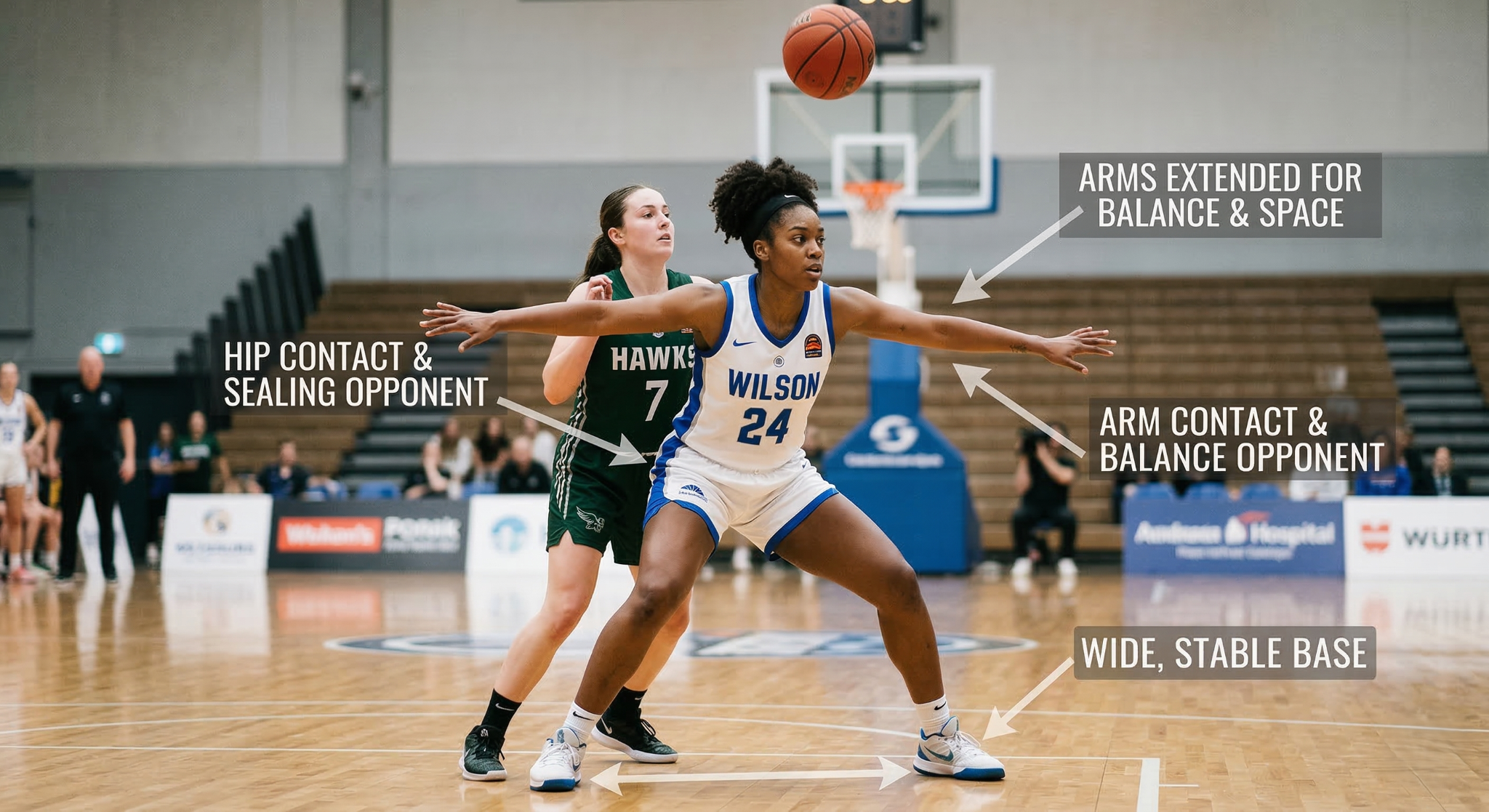
Drill: Partner box-out (10 repetitions)
Work with a partner. One person shoots the ball while the other practices boxing out, making contact with hips and back, then pursuing the rebound. After 10 reps, switch roles. This drill builds the muscle memory for the find-hit-get sequence.
Common Beginner Mistakes (And How To Fix Them)
Over-dribbling: New players often dribble too much because it feels safe, but once the defense is set, that extra dribble just gives them time to rotate and help. Fix: Move the ball early with a pass, then cut hard to create better opportunities.
Standing still after passing: Many beginners pass and then just watch. Fix: After every pass, relocate to a new spot, cut to the basket, set a screen, or fill the empty space. Stay active.
Ball-watching on defense: It’s natural to watch the ball, but that leaves your player open for easy cuts. Fix: Keep one hand in the passing lane and position yourself so you can see both the ball and your player.
Not boxing out: Chasing rebounds without making contact first. Fix: Make contact first (find, hit), then pursue the ball (get). This small habit dramatically improves rebounding.
Rushing lay-ups: Going too fast and losing balance. Fix: Slow down your final step, maintain balance, and finish under control. Controlled beats rushed every time.
Ignoring free throws: Treating them as a break instead of a skill to develop. Fix: Free throws decide close games. Practice them with game-like pressure and develop a consistent routine.
Start Playing With Confidence
If you remember only five things from this guide, make them these: stay balanced in your athletic stance, pass with purpose and accuracy, defend with your feet before your hands, box out and pursue every rebound, and make quick decisions based on what the defense gives you.
The sport looks complicated until the fundamentals become habits. Once you understand the court dimensions, the basic rules, the positions, and the core skills, everything else starts to fall into place naturally. Whether you’re learning for yourself, teaching your daughter, or coaching a team for the first time, this foundation gives you what you need to play with confidence.
Women’s basketball rewards intelligence, teamwork, and consistent skill development. The players who succeed aren’t necessarily the most athletic, they’re the ones who make smart decisions, work on their fundamentals daily, and understand their role within the team structure.
So grab a ball, find a court, and start working on those fundamentals. The best way to learn how to play women’s basketball is simply to start playing.
