

Monica Seles was stabbed on April 30, 1993, during a tennis match in Hamburg, Germany. She was just 19 years old and the world’s number one player with 8 Grand Slam titles. A man named Gunter Parche, who was obsessed with Seles’s rival Steffi Graf, stabbed her in the back with a knife. The attack ended her dominance in tennis, and she stayed away from the sport for 27 months.
The attack that shocked the world
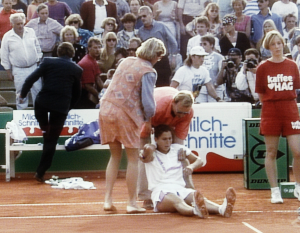
Monica Seles was winning her match. She had just taken the first set 6-4 and was leading 4-3 in the second set against Bulgarian player Magdalena Maleeva. During a break between games, Seles sat on her courtside bench to rest and drink some water.
That’s when Gunter Parche, a 38-year-old unemployed factory worker from Germany, walked down from his seat. He leaned over the barrier separating fans from players. In his hands was a 23-centimeter (9-inch) kitchen knife.
Seles leaned forward to take a sip of water. Parche raised the knife with both hands and stabbed her in the back, between her shoulder blades. The blade went about 1.3 centimeters (half an inch) deep. It narrowly missed her spine and lungs.
Seles screamed and fell forward. Blood stained her white tennis dress. Security guards grabbed Parche before he could stab her again. The 6,000 people watching the match sat in shock. So did the rest of the world when they heard the news.
Who was Monica Seles?
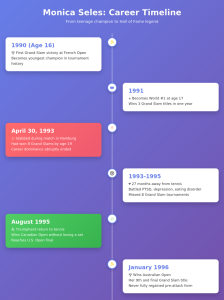
Before the attack, Monica Seles was one of the greatest tennis players ever. Born in 1973 in Yugoslavia (now Serbia), she started playing tennis when she was just five years old.
At age 16, she became the youngest player to win the French Open. By 19, she had won 8 Grand Slam championships, more than any other teenager in tennis history. She had been the world’s number one player for 178 weeks straight.
Seles was known for her powerful playing style. She hit the ball hard with both hands on both sides. She also grunted loudly when she played, which was unusual at the time. Tennis experts believed she could become the greatest player the sport had ever seen.
Why Did Gunter Parche Attack Her?
At first, some people thought the stabbing might be political because Seles was from Yugoslavia, which was going through a war at the time. But that wasn’t the reason.
Parche was obsessed with German tennis star Steffi Graf. He couldn’t accept that Seles had beaten Graf and taken the number one ranking. In his twisted mind, if he hurt Seles badly enough, Graf could become number one again.
Parche had traveled from his home specifically to attack Seles. He bought a ticket, got a seat close to the court, and waited for his chance. This wasn’t a sudden decision, it was planned.
The Trial: A Shocking Result
Six months after the attack, in October 1993, Gunter Parche went on trial in Hamburg, Germany. He admitted to stabbing Seles. There were hundreds of witnesses who saw him do it.
The judge convicted Parche of causing serious bodily harm. But then came the shocking part: his sentence was two years, suspended. This meant he didn’t have to go to prison at all.
The judge said Parche had psychological problems that affected his ability to think clearly. The court believed he wouldn’t attack anyone again. After spending six months in jail waiting for his trial, Parche walked free.
People around the world were outraged. Seles and her lawyers appealed, asking for a tougher sentence. In 1995, a second trial was held. The judge upheld the suspended sentence. Parche still served no additional prison time.
Seles said: “What kind of message does this send to the world? He stalked me, then he stabbed me. And now the court says he doesn’t have to go to jail. He gets to go back to his life, but I can’t.”
27 months away: Seles’s struggle
Doctors expected Seles to heal physically in about three months. The knife wound itself wasn’t that deep or dangerous. But the mental and emotional damage was much worse.
Seles suffered from post-traumatic stress disorder (PTSD). She developed depression and an eating disorder. Loud noises scared her. She couldn’t imagine sitting with her back to a crowd again.
During those 27 months away from tennis, she missed 8 Grand Slam tournaments and 32 other competitions. Meanwhile, Steffi Graf won six of those eight Grand Slams and returned to number one just five weeks after the attack. Parche had gotten exactly what he wanted.
The comeback
In August 1995, Monica Seles finally returned to tennis at the Canadian Open in Toronto. She won the tournament without losing a single set. It was an amazing comeback.
A month later, she played in the U.S. Open and made it all the way to the final. There, she faced Steffi Graf. Graf won in three sets. Seles made the U.S. Open final again in 1996, but lost to Graf again.
In January 1996, Seles won the Australian Open. This was her ninth Grand Slam title, and her last. She never quite returned to the unstoppable form she had before the stabbing. She played until 2003 and officially retired in 2008.
How Tennis changed
After the attack, tennis tournaments made big changes to security:
- Barriers around players were raised from about 3 feet to at least 5 feet tall
- Security guards were placed right next to the court
- Bag checks and weapon screenings became standard
- Players got protected paths to enter and exit courts
No professional tennis player has been stabbed during a match since. However, the threat remains. Female athletes continue to face higher rates of stalking and harassment than male athletes.
What happened to Gunter Parche?
After the trial, Parche lived quietly in Germany. He suffered from health problems and spent the last 14 years of his life in a nursing home in Nordhausen, Germany. He died in August 2022 at age 68.
He never apologized to Monica Seles. He never faced real consequences for destroying one of the greatest careers in tennis history.
Monica Seles today

Monica Seles became a U.S. citizen in 1994. She was inducted into the International Tennis Hall of Fame in 2009. She married businessman Tom Golisano in 2014.
She wrote a book in 2009 called “Getting a Grip” about her struggles with depression and eating disorders after the attack. She also works to raise awareness about mental health issues.
In 2022, Seles was diagnosed with myasthenia gravis, a disease that causes muscle weakness. She made this public in August 2025, showing her continued courage in facing challenges.
Seles vowed never to play tennis in Germany again, and she kept that promise. She couldn’t forgive the German justice system for letting her attacker go free.
What Monica Seles could have achieved
Tennis legend Martina Navratilova said that if Seles hadn’t been stabbed, “We’d be talking about Monica with the most Grand Slam titles.” She might have beaten Steffi Graf’s 22 titles or even Margaret Court’s record of 24.
Before the attack, Seles had won 8 of the last 11 Grand Slams she entered. At just 19 years old, she was completely dominating tennis. There’s no telling how many more championships she would have won.
The Monica Seles stabbing shows how one person’s obsession can destroy greatness. It shows how courts sometimes fail to protect victims. And it reminds us that safety in sports requires constant attention.
Monica Seles’s true legacy
The question “Which female tennis player was stabbed?” has a simple answer: Monica Seles. But the full story is about so much more than just one attack.
It’s about a teenage champion whose career was stolen. It’s about a justice system that failed to protect her. It’s about mental health struggles that people couldn’t see. And it’s about how one moment of violence changed tennis forever.
Monica Seles showed incredible strength by coming back to tennis at all. Even though she never returned to her peak, she proved that she was a fighter. Her legacy is not just the 9 Grand Slams she won, but also her courage in facing unimaginable challenges.