
One gymnast sticks her landing. Another takes a step, and still scores higher. Why? Women’s gymnastics scoring rewards both the difficulty of a routine and how well it is performed.
In elite women’s artistic gymnastics, the basic formula is difficulty score + execution score − separate penalties = final score. Once you understand those parts, the numbers on the scoreboard start to make sense.
This guide covers vault, uneven bars, balance beam and floor under the 2025–2028 international rules. Other competition systems can use different scoring rules.
Women’s gymnastics scoring: the basic formula
A results sheet usually labels difficulty as D, execution as E and separate penalties as Pen. Here is a fictional example:
6.0 difficulty + 8.2 execution − 0.1 penalty = 14.1 final score.
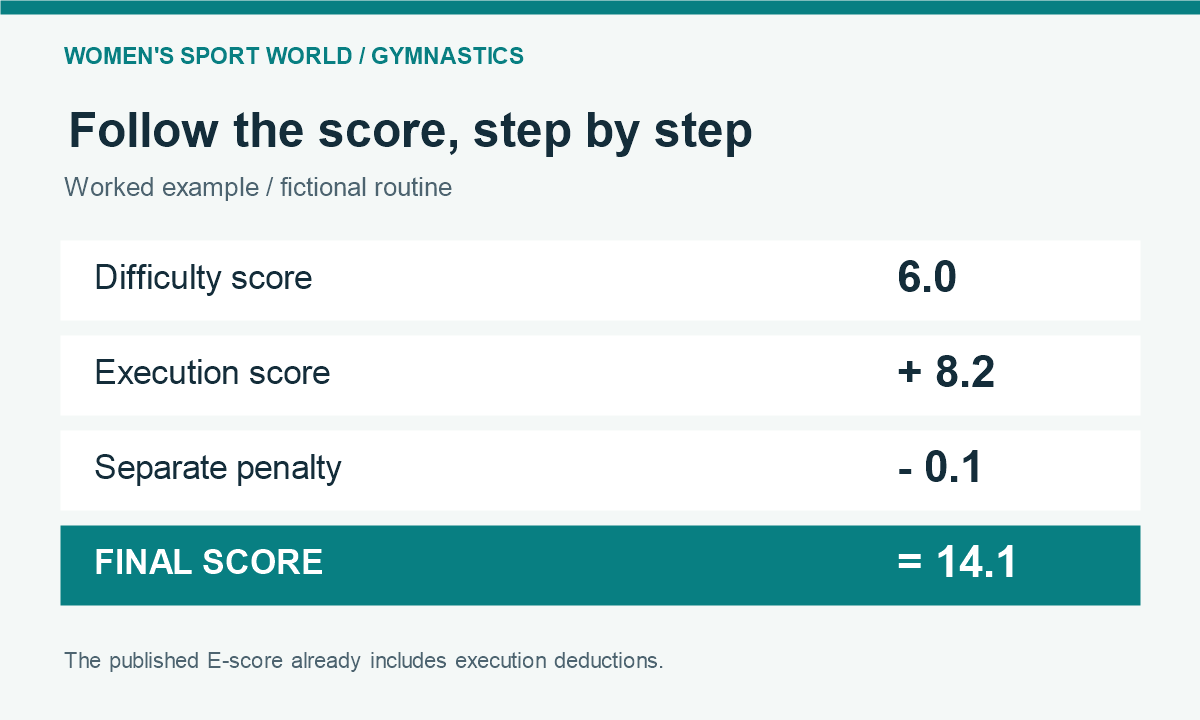
Do not subtract execution deductions twice. The published E-score already accounts for them. An E-score of 8.2 means the execution judging has reduced the starting 10.0 by 1.8 points.
The governing reference is the 2025–2028 Women’s Artistic Gymnastics Code of Points. Vault has additional rules for its two-vault competition, explained below.
What does the difficulty score mean?
The D-score measures the routine content the judges recognise. On bars, beam and floor, it includes credited skills, required routine content and eligible connections or bonuses. Each vault has an assigned difficulty value.
The key word is credited. A gymnast may plan a difficult skill or combination but receive less credit if she does not meet its technical requirements. That is why the difficulty shown on the scoreboard can differ from the score expected before the routine.
For a viewer, this changes what is worth watching. The biggest tumbling pass matters, but so can the way a gymnast links movements. If her D-score drops, look for changed content or lost credit before assuming the execution judges were unusually strict.
What does the execution score measure?
The E-score starts from 10.0. Judges deduct for faults in body position, technique, control and landings. On beam and floor, artistry is also part of execution judging.
A stuck landing helps, but judges assess the whole exercise. Bent knees, poor alignment or a loss of balance earlier in the routine can reduce the score even when the finish looks clean.
Where artistry fits in
On floor, watch how the gymnast connects her movement to the music. On beam, notice the flow and changes of rhythm between skills. These are useful viewing cues, though the judges apply detailed criteria.
Artistry is not a separate extra score added after D and E. World Gymnastics explains its role in execution in the 2025–2028 Code changes.
Gymnastics deductions: what comes off the score?
Execution deductions reduce E. Separate penalties are taken from the total. Keeping those two categories apart makes the scoreboard much easier to read.
| Fault | Deduction | Where it counts |
|---|---|---|
| Fall | 1.0 | Execution score |
| Floor: one foot or hand touches outside the boundary | 0.1 | Separate penalty |
| Body-position or balance fault | Depends on the fault and severity | Execution score |
| Artistry fault on beam or floor | Depends on the criterion | Execution score |
These are examples, not the complete deduction list. Consult Sections 9 and 13 of the current Code for technical and floor-boundary rules. Some time violations also carry separate penalties.
One moment can affect more than one part of the score. For example, a poor floor landing can receive an execution deduction, while touching outside the boundary brings a separate penalty.
Can a gymnast fall and still win?
Yes. A fall costs 1.0 in execution, but the final result still depends on the full awarded scores. It does not automatically place a gymnast behind everyone who stayed on the apparatus.
Suppose a fictional routine loses 1.0 for a fall and 1.5 for other execution faults. Its E-score is 10.0 − 1.0 − 1.5 = 7.5.
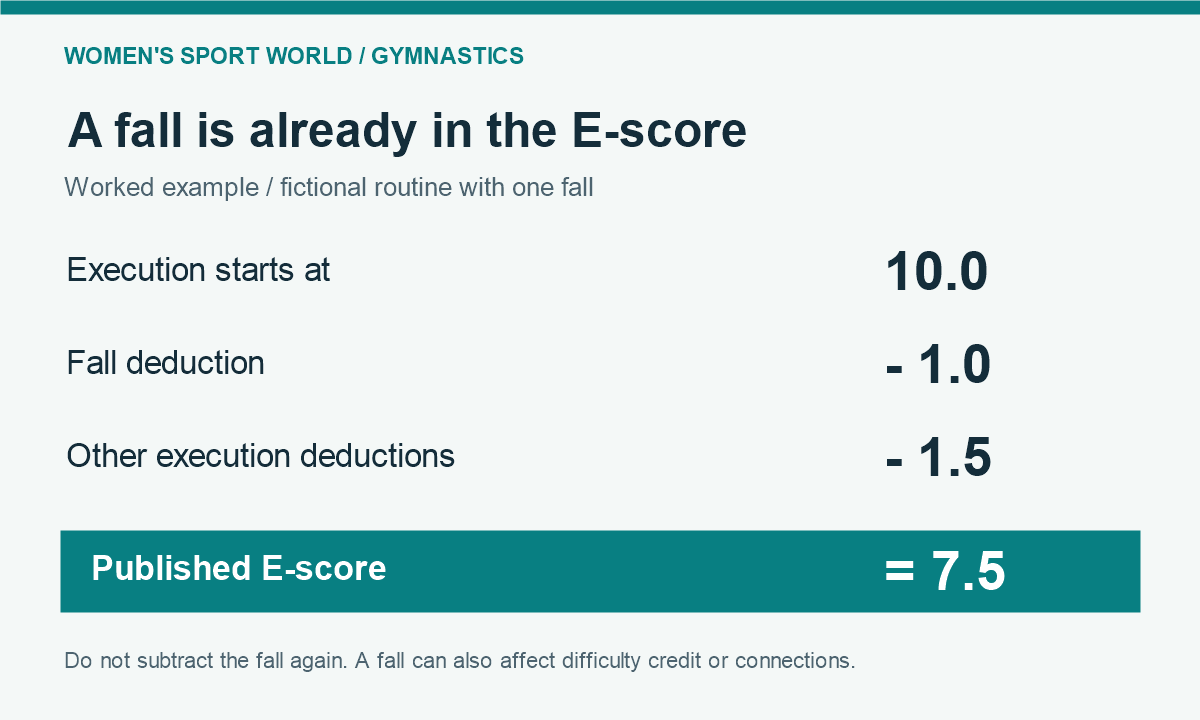
With D 6.5 and no separate penalty, that gymnast scores 14.0. An opponent with D 5.3 and E 8.5 scores 13.8. The gymnast who fell finishes 0.2 ahead.
This illustrates the arithmetic only. A fall can also affect credit for skills or connections, so always use the awarded D-score rather than the planned one.
Why the harder routine does not always win
Now compare two fictional floor routines with no separate penalties:
| Gymnast | D-score | E-score | Total |
|---|---|---|---|
| A | 6.3 | 7.7 | 14.0 |
| B | 5.9 | 8.3 | 14.2 |
Gymnast A has a 0.4 difficulty advantage. Gymnast B gains 0.6 through execution and wins by 0.2. A harder routine creates an opportunity for a higher score; performing it well turns that opportunity into points.
A real example: Kaylia Nemour and Qiu Qiyuan
The Paris 2024 uneven bars final shows how a small execution difference can decide gold. Kaylia Nemour and Qiu Qiyuan both received 7.200 for difficulty.
Nemour earned E 8.500 for a total of 15.700. Qiu earned E 8.300 for 15.500. Their execution gap of 0.200 was also the difference between their final scores.
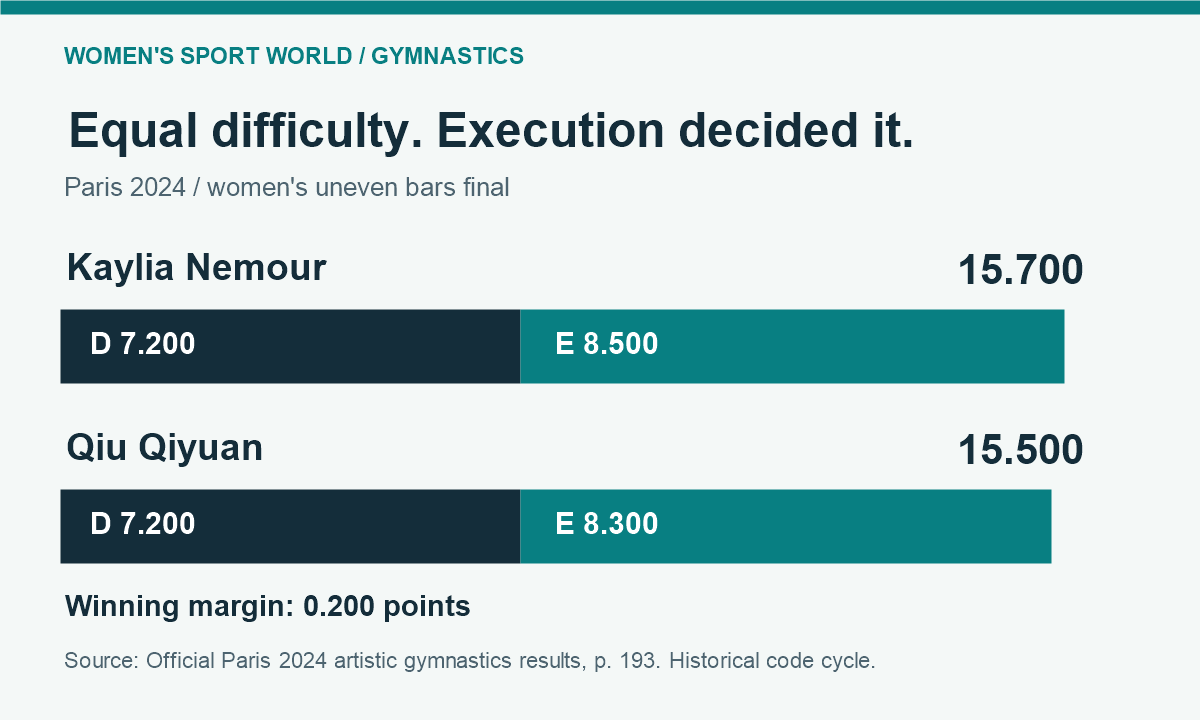
The breakdown identifies execution as the deciding component between those two results. It does not prove that one visible error explains the entire difference. These historical scores also belong to the Paris code cycle; the same routines should not be assumed to receive identical scores under later rules.
How is vault scoring different?
Vault uses an assigned D-value for the vault performed, rather than building difficulty from a long sequence of skills. Judges still assess execution.
For senior international qualification to the vault final and the vault final itself, gymnasts perform two vaults and their scores are averaged. Under the 2025–2028 rules, an eligible pair with forward and backward saltos in the second flight can earn a 0.20 bonus if both vaults are completed without a fall. The bonus is added to the average.
That bonus has specific technical conditions; it is not awarded for simply doing any two different vaults. The senior and junior provisions also differ. See Section 10 of the Code and the British Gymnastics technical update on the vault bonus.
Common questions about gymnastics scores
Is the final gymnastics score out of 10?
No. Execution starts from 10, but difficulty is added separately. The final total is not capped at 10, which is why you see scores such as 14.1 or 15.7.
What is a good score in women’s gymnastics?
There is no single number that guarantees a medal. Compare scores on the same apparatus, in the same competition and round. A score from a different code cycle is not a reliable measure of who performed better.
Do you add a gymnast’s four scores for the all-around?
Yes. The all-around total combines the gymnast’s final scores on vault, uneven bars, balance beam and floor. An apparatus final decides the result on that individual event.
How to read the next score you see
- Read D: how much difficulty did the judges credit?
- Read E: how well was the routine performed?
- Check penalties: is anything taken off separately?
- Compare like with like: use the same apparatus and competition round, and remember the special two-vault calculation.
Watch the entire exercise before judging the result. The landing may be the moment you remember, but the score tells the story of everything that came before it.
Read next: Simone Biles’ gymnastics comeback: what we know.
Which part of gymnastics scoring would you like explained next: bars connections, beam artistry or vault difficulty? Share your question in the comments.